
Bones · Women over 55
It Was Never a Calcium Problem: Carol's Story
For nine years I swallowed a calcium pill the size of a domino. My bone scan still said "osteopenia."

Most women think bone loss is a calcium problem.
It isn't. Here's what it actually was, and the 10-second check that shows whether it's happening to you.
Nine years of doing everything right
My name is Carol. I'm 63. I taught fourth grade for thirty-one years.
And since I turned 50, I did everything I was told to do for my bones:
- ✓A calcium pill with breakfast
- ✓A glass of milk at night
- ✓Vitamin D, because my doctor said so
- ✓A walk most mornings
- ✓Nine years. Every single day.
Then, two years ago, my first bone scan.
The doctor turned the screen toward me and said the word:
Osteopenia.
"Not osteoporosis yet," he said. "We'll keep an eye on it."

I sat in my car in the parking lot for twenty minutes.
My mother broke her hip at 74. She never really walked right again.
Nine years of calcium. So how was this happening anyway?
And I'm far from alone. Government data says about half of American women over 50 have low bone mass.
The domino on my kitchen table
Let me tell you about that calcium pill.
It was the size of a domino. I know because one morning I put them side by side.

Chalky. Sharp edges. I took it in two tries, and some mornings it came back up.
And then there's the part nobody puts on the label. One woman wrote on a menopause forum:
"Went through a bad bout of constipation after I started taking 1200 mg of calcium supplements a day."
I wasn't the only one. On the best-selling calcium on Amazon, 98 of the 143 reviewers who mention the pill size complain about it.
I put up with all of it because I thought I was protecting my bones.
I was solving the wrong problem.
What I found at 2 am
I'm a teacher. When I don't understand something, I read.
The NIH fact sheets. Then the actual studies. Reading glasses on, tea going cold.
And I kept running into the same idea:
Getting calcium into your blood is not the same as getting it into your bones.
Here's the short version, the way I'd explain it to my fourth graders:
Where your calcium goes
Vitamin D3 is the doorman. It helps your gut absorb calcium, so it gets into your blood.
Vitamin K2 is the traffic director. It switches on two proteins:
- ✓Osteocalcin, which binds calcium into the bone itself
- ✓Matrix Gla protein, whose job is to keep calcium out of places it doesn't belong
- ✗Without enough K2, both stay switched off. The calcium is in your blood, and nothing tells it where to go.
I read that sentence four times.
Nine years of calcium. And nothing in my cabinet was telling it where to go.
It was never a calcium problem. It was a directions problem.
Where does the calcium go instead?
This is the part that scared me more than the scan.
The Rotterdam Study followed 4,807 adults in the Netherlands for years.
The people who ate the most vitamin K2 had about half the rate of severe calcification in the aorta, the body's main artery, compared with the people who ate the least.
And when researchers pooled the trials of calcium pills taken without vitamin D, they found them linked to more heart attacks.
I'd been swallowing calcium for my bones for nine years. I had no idea where it was ending up.
Not because I did anything wrong. Because one piece was missing from the instructions.
Do this now: the 10-second bottle check
Go get your calcium or vitamin D bottle. Turn it over to the Supplement Facts panel.
- ✓Look for "Vitamin K2" or "menaquinone." Plain "vitamin K" or "phylloquinone" is K1, a different form.
- ✓Found it? Good. You can close this page.
- ✗No K2 on the label? Then nothing you take is telling that calcium where to go. Keep reading.
Why I didn't just buy another bottle
I went to the pharmacy to buy K2. I stood in the aisle with a bottle in my hand… and thought about my kitchen counter.

Calcium. D3. Fish oil. My blood-pressure pill. Magnesium. Something for my eyes.
Nine pills every morning. I did not want a tenth.
And I'm not unusual: in one survey, more than a third of adults said they have trouble swallowing pills.
My mornings, before and after
That's when I found the strip.

The one vitamin I don't have to swallow
It's called Halvi Bone.

A thin raspberry strip, about the size of a postage stamp. It melts on your tongue in seconds.
No water. Nothing to swallow. No domino.
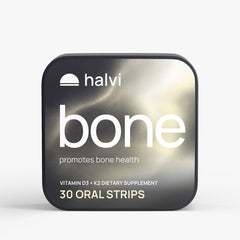
In every strip
Halvi Bone · 30 strips per tin
- D3Vitamin D32,000 IU (50 mcg)
- K2Vitamin K2120 mcg
- Raspberry · nothing to swallow · no calcium, on purpose
- ✓Vitamin D3, 2,000 IU: the doorman, helps you absorb calcium
- ✓Vitamin K2, 120 mcg: the traffic director, helps put that calcium to proper use
- ✓No calcium, on purpose: get your calcium from food. The strip adds the two vitamins that help your body use it.
Every morning, with your coffee
- 1Open the tinTake out one strip
- 2On your tongueNo water needed
- 3Gone in secondsRaspberry
I keep the tin next to my coffee maker. Strip on my tongue, then the coffee. That's it.


What changed
The domino is gone. So is the glass of water, the gagging and the bloated afternoons.
For the first time in eleven years, I'm not just swallowing calcium and hoping.
I know what every single thing I take is for. And the piece that was missing is now the easiest thing I do all day.

My mother never got to dig in the garden with her great-grandchildren.
I plan to.
Calcium pill vs. vitamin D vs. the strip
| Calcium pill | Vitamin D only | Halvi Bone strip | |
|---|---|---|---|
| Helps absorb calcium | ✗ | ✓ D3 | ✓ D3, 2,000 IU |
| Helps direct calcium to proper use | ✗ | ✗ | ✓ K2, 120 mcg |
| Swallowing | ✗ Domino-sized tablet | ✗ Capsule | ✓ None, melts on the tongue |
| Constipation complaints | ✗ Common | — | ✓ No calcium in it |
| Cost per day | Varies | Varies | ✓ $0.83 on the 3-tin plan |
Here's exactly what to do next
- ✓1. Do the bottle check tonight. No K2? You're missing the piece I was missing.
- ✓2. Pick your supply below. We recommend the 3-tin plan: 90 days, the lowest price, $0.83 a day.
- ✓3. Put the tin by your coffee maker. One strip every morning. Raspberry. Ten seconds.
- ✓4. Give it the full 60 days. Not happy? Email us. Every cent back, and you keep the tin.
60-day money-back guarantee
Try it for 60 days. Not happy? Email us and get every cent back. No questions. You keep the tin.
60-day money-back guarantee
Pick your supply
60-day results guarantee
Feel the difference in 60 days, or get every cent back. Keep the tin.
Questions
Does it have calcium in it? No, on purpose. It pairs D3 with K2, the two vitamins that help your body absorb and use calcium. Get your calcium from food.
I already take vitamin D. Can I take this too? Count your total. Each strip has 2,000 IU of D3. You can swap your D pill for the strip and get the D3 and the K2 in one step.
I take a blood thinner. Ask your doctor before taking any vitamin K product. Vitamin K can interact with blood thinners like warfarin.
How do I take it? One strip a day, on your tongue. It melts in seconds. No water.
When does it arrive? Free US shipping on the 3-tin plan; single tins ship for $8. Usually arrives in about a week.
Can I cancel the plan? Yes. Three tins ship every 3 months at $24.99 a tin ($74.97). Skip or cancel any time before your next order.
What if I don't like it? Email support@halvi.co within 60 days. Full refund. You don't need to send anything back.
Claim 37% off the 3-tin plan →
P.S. Do the bottle check tonight. It takes ten seconds.
If you see K2 on your label, good: you can close this page.
If you don't, you're where I was two years ago. And now you know it was never a calcium problem.
Sources
- NIH Office of Dietary Supplements. Vitamin K: Fact Sheet for Health Professionals.
- NIH Office of Dietary Supplements. Vitamin D: Fact Sheet for Health Professionals.
- Geleijnse JM et al. Dietary intake of menaquinone is associated with a reduced risk of coronary heart disease: the Rotterdam Study. J Nutr. 2004;134(11):3100–5.
- Bolland MJ et al. Effect of calcium supplements on risk of myocardial infarction and cardiovascular events: meta-analysis. BMJ. 2010;341:c3691.
- Schiele JT et al. Difficulties swallowing solid oral dosage forms in a general practice population. Eur J Clin Pharmacol. 2013;69(4):937–48.
- National Center for Health Statistics. Osteoporosis or Low Bone Mass in Older Adults: United States, 2017–2018. NCHS Data Brief No. 405, 2021.